Introduction
As modern applications grow, backend systems must handle increasing amounts of data, concurrent users, and analytical workloads without sacrificing performance. Traditional CRUD-oriented architectures often become bottlenecks when transactional operations and analytics queries compete on the same database layer.
While building data-intensive applications such as CricMetrics, I encountered challenges related to query performance, scalability, and large-scale aggregation processing. To solve these problems, I designed a backend architecture using FastAPI, PostgreSQL, and ClickHouse — combining transactional reliability with high-performance analytics.
This article explains the architectural decisions, database strategies, and scalability improvements behind that system.
The Problem with Traditional Backend Architectures
Most beginner-level applications rely on a single relational database for everything:
- User authentication
- Transactions
- Reporting
- Analytics
- Aggregations
- Dashboards
This works initially, but as datasets grow, analytical queries begin impacting transactional performance.
For example:
- Complex GROUP BY operations become slow
- Dashboard APIs start increasing latency
- Heavy aggregations lock important resources
- Query response times become inconsistent
In analytics-heavy systems, this architecture eventually becomes difficult to scale.
To avoid these bottlenecks, I separated transactional and analytical workloads into different layers.
Why FastAPI?
FastAPI became the API layer for this architecture because of its performance, asynchronous support, and developer productivity.
Key advantages include:
- High-performance ASGI architecture
- Native async request handling
- Automatic OpenAPI documentation
- Type validation using Pydantic
- Cleaner and more maintainable API design
Compared to traditional synchronous frameworks, FastAPI handled concurrent requests far more efficiently in workloads involving large analytical queries and background processing.
In my projects, FastAPI significantly reduced API latency while improving development speed and maintainability.
PostgreSQL for Transactional Workloads
PostgreSQL was used as the primary relational database for transactional operations.
The system handled:
- User data
- Match metadata
- Authentication
- Relationships
- CRUD operations
- Core application entities
To improve performance and maintain scalability, several optimizations were applied:
Schema Design
The database schema was normalized to reduce redundancy and improve data consistency.
Query Optimization
Indexes were added on frequently queried fields such as:
- player identifiers
- match identifiers
- timestamps
- filtering columns
This reduced query execution time substantially for high-frequency API endpoints.
Materialized Views
For expensive aggregations that were repeatedly accessed, materialized views were introduced to cache computed results and reduce database load.
PostgreSQL performed exceptionally well for transactional consistency and relational queries when properly indexed and optimized.
Scaling Analytics with ClickHouse
As datasets crossed hundreds of thousands of rows, PostgreSQL alone became inefficient for analytical operations.
Queries involving:
- large aggregations
- statistical summaries
- GROUP BY operations
- historical comparisons
started becoming resource-intensive.
To solve this problem, ClickHouse was introduced as the analytical database layer.
Why ClickHouse?
ClickHouse is a column-oriented database specifically optimized for analytics workloads.
Unlike PostgreSQL, which is row-based and optimized for transactions, ClickHouse is designed for:
- extremely fast aggregations
- analytical queries
- time-series workloads
- large-scale reporting systems
Key Benefits
Columnar Storage
Only required columns are scanned during queries, dramatically improving analytical performance.
Fast Aggregations
Large GROUP BY operations executed significantly faster compared to PostgreSQL.
Compression Efficiency
Columnar storage also improved storage efficiency for large datasets.
In the CricMetrics analytics engine, ClickHouse improved heavy query performance by nearly 20–30x for certain aggregation workloads.
Background Processing with Celery
Heavy operations such as:
- analytics generation
- scheduled updates
- background synchronization
- long-running computations
were moved to asynchronous workers using Celery.
This ensured that expensive tasks did not block API requests or increase user-facing latency.
The overall architecture became significantly more responsive after introducing background task processing.
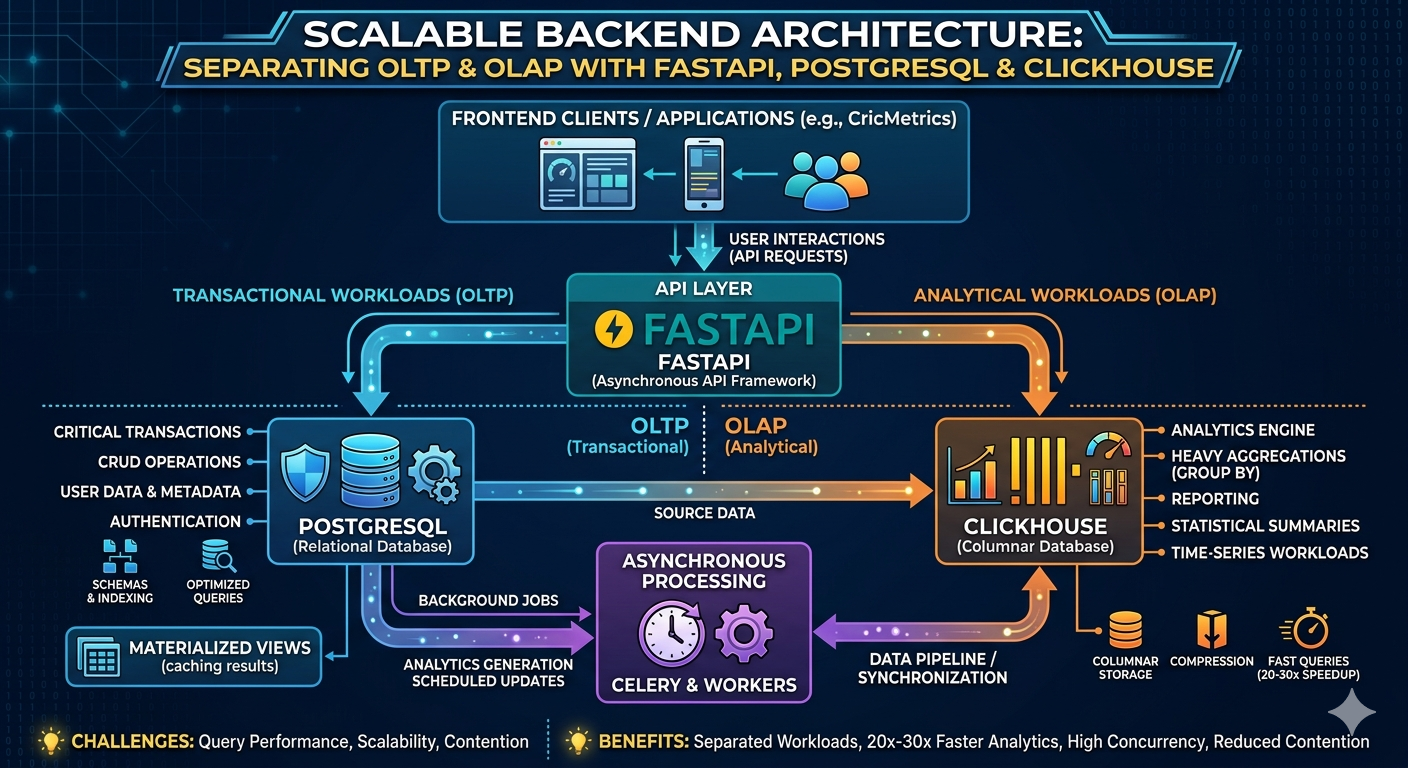
System Architecture
The final architecture followed a hybrid backend approach:
- FastAPI handled API communication
- PostgreSQL managed transactional data
- ClickHouse powered analytics workloads
- Celery handled asynchronous background jobs
This separation allowed each component to focus on the workload it was optimized for.
As a result:
- API latency improved
- database contention reduced
- analytical queries scaled efficiently
- background jobs became isolated from request processing
Key Engineering Learnings
Building this architecture taught several important backend engineering principles:
Separate OLTP and OLAP Workloads
Transactional databases and analytical databases solve different problems. Combining both on the same layer eventually creates scalability bottlenecks.
Optimize Before Scaling Infrastructure
Query optimization and indexing often provide larger performance gains than simply upgrading server resources.
Use Async Processing Strategically
Heavy tasks should never block real-time API responses.
Measure Performance
Performance improvements should always be validated using benchmarks, profiling, and query analysis.
Conclusion
Designing scalable backend systems requires more than simply building APIs. Modern backend engineering involves understanding workload separation, database architecture, asynchronous processing, and performance optimization.
FastAPI, PostgreSQL, and ClickHouse together provide a powerful stack for building modern, data-intensive applications capable of handling both transactional reliability and large-scale analytics efficiently.
As applications continue growing in complexity and scale, architectural decisions become just as important as the code itself.